
Analytics tells you where people left. It never tells you why. If your site gets twenty visitors a day, it barely tells you where either. The way to find out why was always a focus group, which means a recruiter, a room, a week and a few thousand dollars, so almost nobody with a small website ever ran one.
Starting today, TopSyde runs website focus groups. You write a brief, we build an audience from industry data for your kind of business, and 100 simulated customers read your site, page by page, and tell you in their own words why they would or would not do the thing you want them to do. The report lands in about 15 minutes. It costs $99 once, and hosting customers get the first 100 participant group on each hosted site included.
Before we let anyone else run one, we ran it on topsyde.com. The results are below, including the parts that stung.
What a focus group is here
Each participant is its own AI agent playing one buyer or lead. Not one model asked the same question a hundred times, which gives you one opinion a hundred ways, but a hundred different people with different reasons.
It starts with the brief. You say who should take part ("homeowners in the Boise area who need a roof repaired, including people dealing with storm damage and an insurance claim"), what counts as converting ("request a quote") and up to five questions of your own. We then research who actually buys from businesses like yours, with web search, and turn that into three to six groups with real-world shares and trait ranges. For a roofer that might be storm victims with an insurance claim, people planning a replacement next year, landlords and property managers, and homeowners comparing three quotes. You see the mix and can change any share before paying.
Every participant is sampled from that mix in code, then written as a person. A name, a situation, how much they have to spend, how urgent it is, how patient they are, whether they are on a phone. Then they visit. They land on the page you chose and read it, choose from the real links on that page, read the next one, and keep going until they act, leave or run out of patience. Afterwards they answer in character. Would you do it today? Why not? What did you like? What put you off? What was confusing or missing? And your own questions.
The report counts everything from those answers. Conversion overall and by group. The reasons, grouped into themes, each naming the participants behind it so the count is a count of real rows. What people liked and what turned them off. Which pages were seen and where people stopped. Your questions, summarised with the themes. Then the fixes, ordered by how many participants they would help, with a button that opens a ticket to our developers with the list already written.
What it said about topsyde.com
We briefed it with the people we actually want. Small business owners who have been let down by their host, owners paying a developer by the hour, owners whose site has been hacked, agencies and freelancers, and people comparing prices. Converting meant starting the free trial.
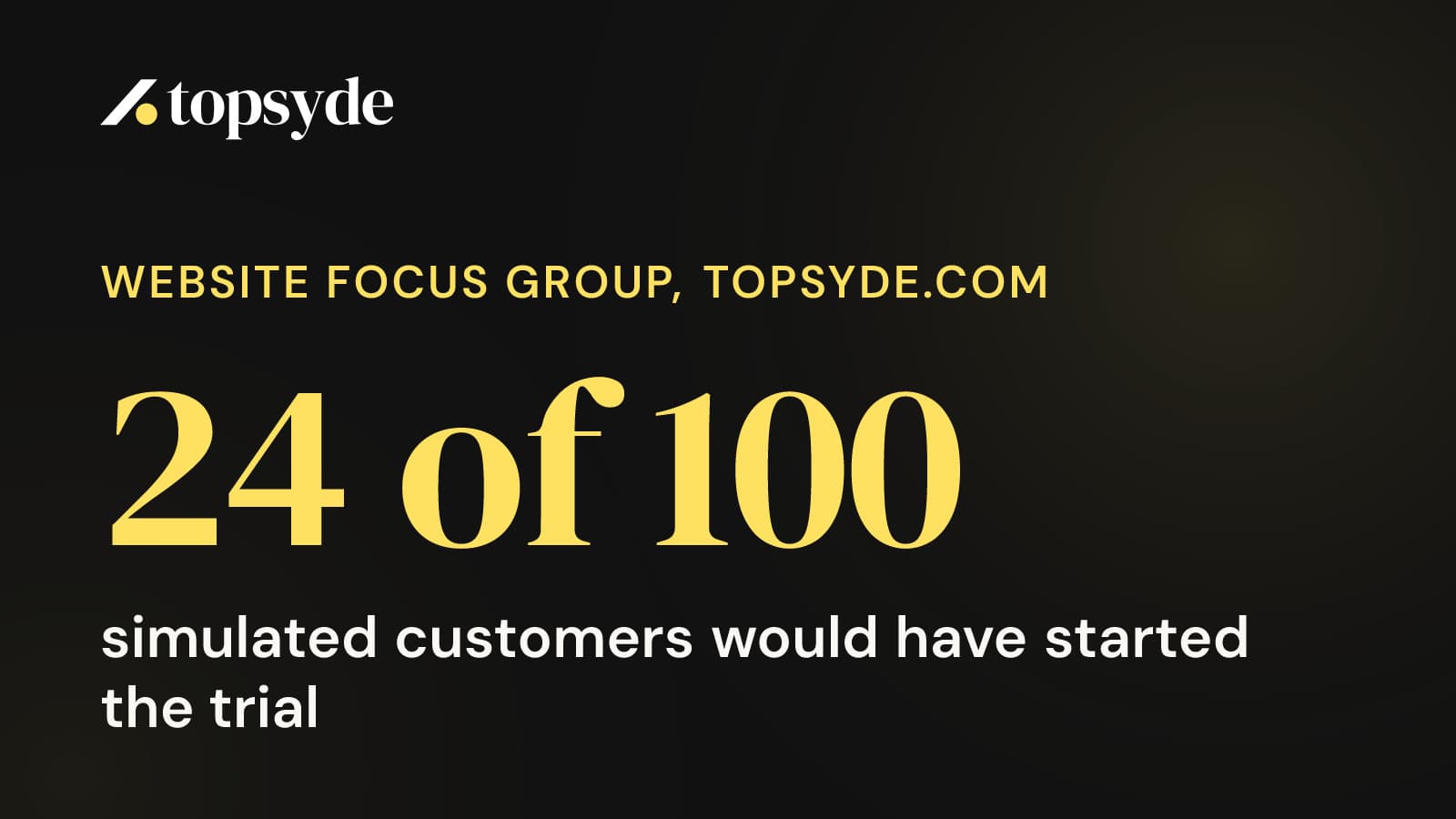
24 of 100 would have. By group it was very uneven. Half of the owners with a hacked or broken site would have started. 38% of owners paying a developer. 24% of those let down by their host. 5% of agencies and freelancers, and none of the price comparers.
The reasons the other 76 gave, counted:
- The FAQ page showed questions with no answers under them. 32 participants. Our FAQ answers were loaded by a script after the page arrived, so anyone reading the page's words saw a list of questions and nothing else. Search engines and AI assistants read pages the same way. We had a FAQ page that answered nothing to anyone who was not a browser.
- No phone number or chat on the pages they read. 29 participants. The number exists. It was not on the pages people actually visited on the way to deciding.
- No plain list of everything the plan includes. 21. We say "everything included" a lot. People wanted the list.
- No pricing for agencies between one site and three hundred. 17.
- Nothing about what happens to business email during a migration. 12. The single most common fear in the hosting business, and we had not written a sentence about it.
- No founder, team or About page. 11.
- "Unlimited" with no numbers behind it. 7.
One quote, from a participant written as the owner of a twelve person law firm who had been let down by her host. "I got as far as the pricing page and still could not tell what happens to my email during the move. I would have called if I had seen a number."
None of this needed a hundred people to be true. All of it needed a hundred people to be heard. We had looked at those pages every day for a year.
What we are changing
The FAQ answers are going into the page itself, where every reader gets them. The phone number is going on the pages people read before deciding. We are writing the plain list of what the plan includes, the answer about email during migration and the answer about what unlimited means, and the agency pricing and the team page are on the list behind them. When the changes are live we will run the group again on the same brief and publish the second number next to the first.
Where it is useful
Sites with little traffic. A/B testing needs thousands of visitors to say anything, and speed work only helps the people who were going to act anyway. A focus group gives you a hundred people's reasons on a site that gets twenty a day.
Before a redesign. Run one on the current site, and one on the new one before it goes live. The first tells you what the redesign has to fix. The second tells you whether it did.
A landing page or pricing page. Start the group on the page that matters and ask the question you argue about in meetings. Is it the price that puts people off, or the missing phone number?
Agencies pitching a client. A report in the client's own customers' words, with counted reasons and quotes, makes a stronger case for the work than a list of best practices. Run it on the client's site before the pitch, and once the site is on an agency plan the first group on each site is included.
What it does not do
The participants are simulated. They are drawn from industry data and from your own site, and in our runs the direction has been reliable and the reasons specific enough to act on. The exact percentages are not a forecast. Treat the reasons as the strongest hypotheses to test.
They read the words on your pages and the links between them, the way a search engine or a screen reader does. They do not see your design, your colours or your photos. A group tells you about your message, your offer, your prices and what is missing, not about how the site looks.
It reads up to 40 pages of a site once, and every participant browses that copy, so your site never knows it happened and nothing on it changes.
What it costs
$99 for 100 participants, or $349 for 500 when a site has several audiences and you want each one large enough to compare on its own. Paid once by card, and a group runs the moment it is paid for, so it cannot be refunded. Nothing is charged until you have seen and approved the audience.
Hosting customers get the first 100 participant group on each hosted site included with the plan, from $89/site/month, alongside the weekly AI visibility check, AI edits and the rest of the eight tools built into hosting. After that first group, each one is $99. The plan's own details are on the FAQ.
Frequently Asked Questions
Are the participants real people?
No. Each one is an AI agent written as one person, sampled from an audience model we research for your kind of business. They read your actual pages and answer in character. The reasons are hypotheses to test, not a vote.
Can I choose who takes part?
Yes. You describe them in the brief, we turn that into groups with real-world shares, and you can change any share before paying. You also choose the page they land on and what counts as converting.
Do I have to host with TopSyde?
No. Anyone can run a focus group on any public website. Writing the brief opens a free TopSyde account under your email, where the report is kept. Hosting customers get the first group on each hosted site included.
How long does it take?
About 15 minutes for 100 participants and about 45 for 500. You can watch it run, with a count of who has finished and how many would act so far, and we email you when the report is ready.
Will you make the changes it recommends?
If we host your site, yes. The fixes in the report come with a button that opens a ticket to our developers with the list filled in. If we do not host it, the fixes are yours to make, or we can quote the work.
Want to know why your visitors leave? Run a focus group, or see what hosting includes.

Founder & Lead Developer
20+ years full-stack development, WordPress, AI tools & agents
Colton is the founder of TopSyde with 20+ years of full-stack development experience spanning WordPress, cloud infrastructure, and AI-powered tooling. He specializes in performance optimization, server architecture, and building AI agents for automated site management.